Andhravani Editorial — The world's richest man says a handful of Indian billionaires have a monopolistic chokehold on 1.4 billion people. The Government of India says he is wrong. Both claims deserve scrutiny, and neither side comes out of this week looking clean.
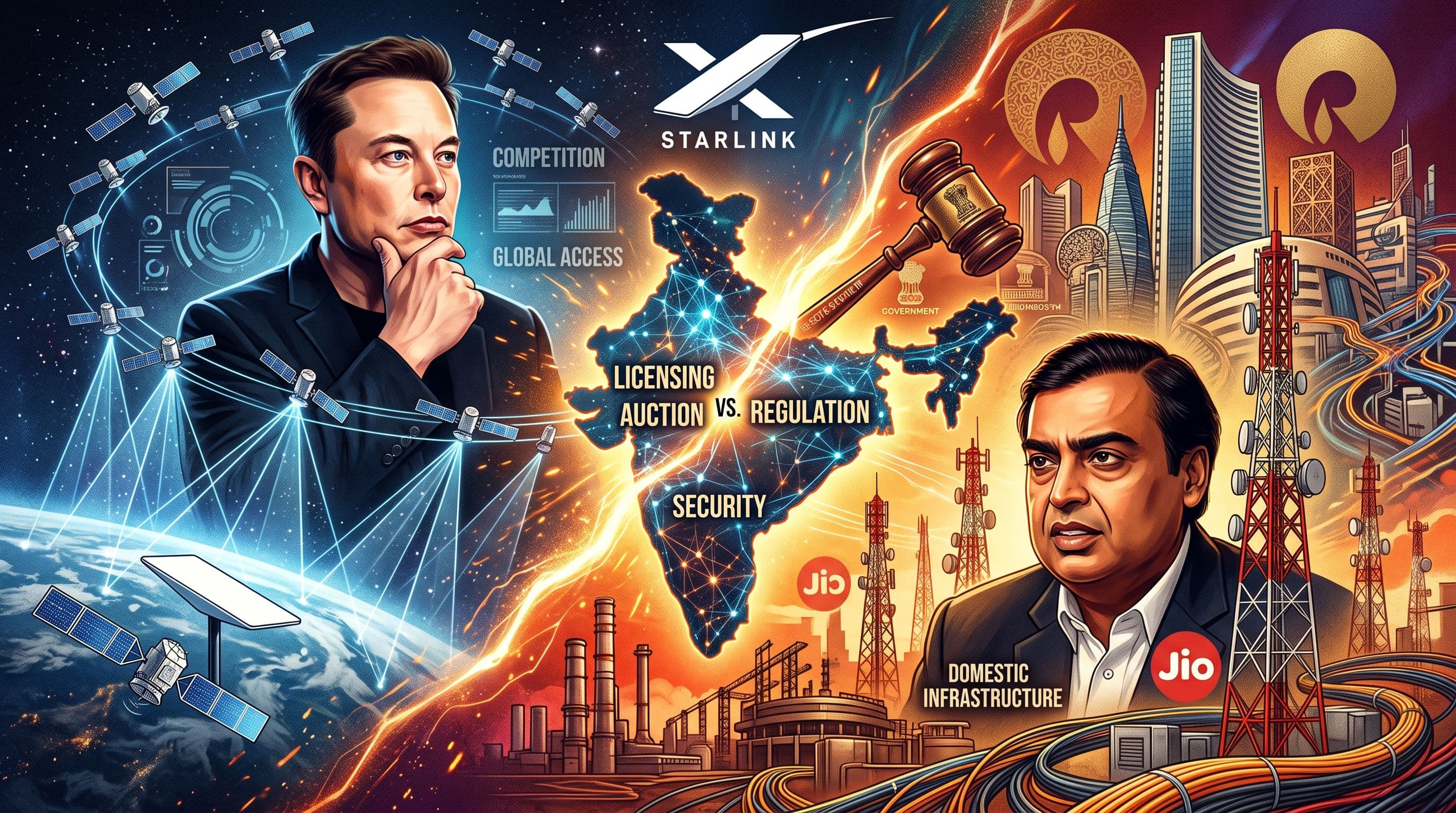
On October 7, Elon Musk posted on X that Starlink, his satellite internet service, was being blocked in India by "certain oligarchs" protecting their grip on the market, and called it a crime against the people of India. A day later he asked whether Mukesh Ambani is "the real boss of India." On October 9 he went further, addressing a sarcastic post to "Prime Minister Ambani." The Ministry of Communications, without naming Musk, called the charge of unfair treatment baseless and misconceived.
Three questions matter here. What does Musk actually want in India? Why is he fighting the government and the Ambanis? And when a trillionaire who spent hundreds of millions of dollars on American elections calls others oligarchs, is he describing them, or himself?
What Musk wants in India
Starlink. Musk pitches satellite internet as a lifeline for villages with weak or no mobile coverage, and for disaster zones where ground networks fail. It is a proven product. SpaceX runs the world's largest satellite constellation, and Starlink already operates in well over 100 countries. In the same week Musk attacked Ambani, SpaceX launched its phone-to-satellite service next door in Bangladesh.
Tesla. Tesla opened its first Indian showroom in Mumbai's Bandra Kurla Complex in July 2025. It sells imported cars that carry roughly 70% in duties and levies. India's EV scheme lets carmakers import up to 8,000 cars a year at a 15% duty, but only if they invest about ₹4,150 crore (roughly $500 million) and start local manufacturing within three years. In June 2025, Heavy Industries Minister H.D. Kumaraswamy said Tesla only wanted showrooms and was not interested in manufacturing in India.
X and Grok. X is one of India's most important political platforms. It is in court against the government over how posts are taken down, and its AI chatbot Grok drew a formal government notice earlier this year.
Five years of waiting
- 2021: Starlink's first attempt collapses after it takes pre-orders without a licence.
- October 2024: The government decides satellite spectrum will be assigned administratively, not auctioned. That was Musk's position, not Ambani's.
- December 2024: A Starlink-labelled device is seized from militants in Manipur. Musk says Starlink's beams were never switched on over India.
- March 2025: Airtel and Jio both sign deals to sell Starlink equipment in their stores.
- June 2025: The Department of Telecommunications grants Starlink its operating licence.
- August–October 2025: Starlink receives trial spectrum and, from October 30, runs security demonstrations for law-enforcement agencies in Mumbai.
- June 2026: Bloomberg reports that Home Ministry security agencies have frozen Starlink's final clearances. Starlink disputes the report.
- October 2026: The security clearance, FDI approval and the final spectrum price are all still pending.
Why the government is holding back
Who controls the switch in a war. Indian authorities have reportedly asked Starlink how it would follow Indian security orders during a conflict if a foreign government made conflicting demands. Operators must be able to cut service to individuals, groups or entire areas during hostilities. Starlink says its Indian setup meets those rules. The ministry says the security check is still under way for all three satellite licensees and has given no timeline.
This concern is not paranoia. Starlink kits have turned up with insurgents in Manipur and with drug smugglers off the Andaman Islands. In 2022, Musk himself refused a Ukrainian request to switch on Starlink near Crimea for a military operation, proof that one man can decide where the network works during a war. A sovereign country asking hard questions about that is doing its job. It is not serving Ambani.
The spectrum price. The government sided with Musk on how spectrum is allotted, but it has not fixed the price. TRAI recommended a charge of 4% of adjusted gross revenue. The figure now under discussion is about 5%, and it still awaits Cabinet approval.
Free speech and AI on X. X has challenged the Home Ministry's Sahyog portal, which lets officials across the country send takedown orders to platforms. X argues that the portal bypasses the safeguards of Section 69A of the IT Act, the blocking route the Supreme Court upheld in 2015. The Karnataka High Court upheld Sahyog in September 2025. X appealed, pointing out that it had complied with 26,641 of 29,118 government requests in the first half of 2025. In July 2026, at the Centre's request, the Supreme Court paused X's appeal and three other High Court challenges to Sahyog, including one by comedian Kunal Kamra, while it considers hearing them all itself.
Separately, in January 2026 the IT ministry served X a notice after Grok was used to create sexually explicit images, particularly targeting women and children. According to government sources, X admitted lapses, removed the content and deleted about 600 accounts. On Sahyog, Musk raises a free-speech concern that many Indian digital-rights groups share. On Grok, the government was plainly right.
The Ambani angle
The Musk–Ambani rivalry is real. Jio and Airtel together hold more than 80% of India's broadband market, about 910 million subscribers. Jio has paid around $19 billion in spectrum auctions and fears losing customers to satellite services. Musk is known for undercutting incumbents. In Kenya, Starlink offered a $10-a-month plan, against about $120 a month for its standard US service.
Reliance argued that satellite spectrum should be auctioned so that foreign operators pay what Indian telcos paid. Musk argued that this spectrum is shared by international convention and should simply be assigned. The government chose Musk's model. Ambani lost that fight.
That is the biggest hole in Musk's accusation. Several other facts also cut against it:
- The key spectrum decision went against Ambani.
- Jio itself signed up to sell Starlink equipment.
- Jio's own satellite arm and Airtel-backed OneWeb are stuck at the same security stage. Sunil Bharti Mittal said he too is waiting for approvals.
- Musk has offered no evidence that Ambani has any role in the security review.
In fairness to Musk, incumbents in every country lobby to slow down disruptive rivals, and India's regulatory process is slow and opaque. When a decision drags on for months with no public explanation, suspicion fills the gap.
How India reacted
- Rahul Gandhi, Leader of the Opposition in the Lok Sabha, replied: "Welcome to India, Elon. Wait till you discover the other guy." This was widely read as a reference to Gautam Adani. Musk thanked him and called the situation troubling.
- K.T. Rama Rao, former Telangana IT minister, challenged Musk to name the oligarchs he meant.
- The central government rejected the claim as baseless. Pro-government voices called Musk's post ill-informed.
- Industry: Sunil Mittal said OneWeb is also waiting for approvals. Jio's Akash Ambani declined to comment.
- Users: Some Indian X subscribers posted screenshots of cancelled subscriptions in protest.
There is irony on every side. In 2025 the Congress accused Prime Minister Modi of arranging the Jio and Airtel deals with Starlink to win favour with President Trump through Musk. Today the same party is cheering Musk. In 2023 Musk said he was a fan of Modi. Today he suggests Modi is not the real boss.
Is India run by oligarchs?
An oligarch, strictly speaking, is not simply a very rich person. An oligarch is someone whose wealth buys political power, and whose political power then protects that wealth. The real test is whether the rules bend for them.
By that test, India has a genuine concentration problem in some sectors. Two private companies dominate telecom after a decade of mergers, exits and price wars. A few conglomerates, Reliance and Adani above all, span energy, ports, retail, media and telecom. The opposition has long accused the government of favouring them. The government denies it.
The Starlink case, though, is weak evidence for Musk's charge. In the single decision Musk is angriest about, the state overruled India's richest man in Musk's favour. Jio's rise also made Indian mobile data among the cheapest in the world, which is not what monopolists usually do. The current block is a security review that applies equally to three companies, including Jio's own satellite arm.
India's real question is not whether Ambani secretly controls ministries. It is whether a few conglomerates are becoming too big for regulators to say no to. That debate is worth having, with or without Musk.
Is Musk an oligarch himself?
By the same test he applies to Ambani, Musk fits the description at least as well. He built his companies rather than inheriting them. But he has also used money and political access to shape the rules those companies operate under.
- Wealth: SpaceX's June 2026 IPO priced the company at about $1.77 trillion, the largest listing in history. Shares rose nearly 20% on the first day, pushing its market value past $2 trillion and making Musk the world's first trillionaire.
- Control: He was expected to own about 42% of SpaceX's shares but hold about 79% of its voting rights. US pension funds objected to this super-voting structure.
- Media: X is now part of SpaceX through xAI. One man owns a rocket company, a satellite network, an AI lab and one of the world's largest political megaphones.
- Political money: He spent about $290 million in the 2024 US election cycle, mostly backing Donald Trump.
- Government power: He led the Department of Government Efficiency (DOGE) in 2025 while his companies held billions of dollars in federal contracts. He denied any conflict of interest.
- Spectrum: SpaceX bought EchoStar's airwaves for $17 billion after the FCC, chaired by Brendan Carr, seen as a strong SpaceX ally, pressed EchoStar over unused spectrum, and President Trump urged a deal.
- Market dominance: Starlink operates roughly 65% of all active satellites on Earth.
The spectrum point stands out. In India, Musk argues that satellite airwaves are a shared resource and should not be sold. In America, his company bought exclusive airwaves after regulators leaned on the seller. The bands are technically different, but the instinct is the same: use whichever rule, and whichever political connection, gets Starlink the spectrum.
India is also not the first country where Musk has turned a licensing dispute into a story of personal persecution. In South Africa, he says Starlink is shut out because he is not Black. The regulator said in 2025 that Starlink had not even applied for a licence. The government has since allowed an alternative to its 30% local-ownership rule, though the regulator has yet to put it into effect.
In Musk's defence, he made his fortune by building products people want to buy, against long odds. SpaceX's market share comes largely from cheaper launches, although NASA contracts helped it grow. And he is right that Indian consumers would benefit from more competition.
Is Musk right?
Musk is right about the goal and wrong about the villain.
Where Musk is right:
- Remote villages, the Himalayan states, the Northeast and disaster-hit areas need connectivity that towers and fibre have not delivered.
- Five years is a long wait, and a security review with no deadline invites suspicion.
- More competition in a two-player market tends to bring prices down.
- X's challenge to opaque takedown orders raises a genuine free-speech question that matters to every Indian, not only to Musk.
Where Musk is wrong:
- He accused a named Indian citizen of controlling the government without offering any evidence.
- He ignored that the government overruled Ambani in his favour, and that Jio and OneWeb face the same check.
- He brushed aside a legitimate security question: who controls a foreign-run network during a war.
- He is himself one of the clearest modern examples of wealth turned into political power, which makes "oligarch" an awkward insult for him to throw.
What New Delhi should do: Publish a timeline for the security review, apply it equally to all three licensees, and finalise the spectrum price. Transparency is the best answer to a charge of capture. Silence only feeds it.
What Musk should do: Make his case to Indian regulators and courts, as X is already doing on Sahyog, rather than to his followers on X. India's sovereignty over its own airwaves and security is not something to be negotiated by tweet, whoever is tweeting.
Indian readers can hold two ideas at once. Big business has too much influence in India. And the world's richest man is not a neutral messenger for that truth.
This is an Andhravani editorial. Andhravani will continue to follow the Starlink approval process and update readers as the government responds.