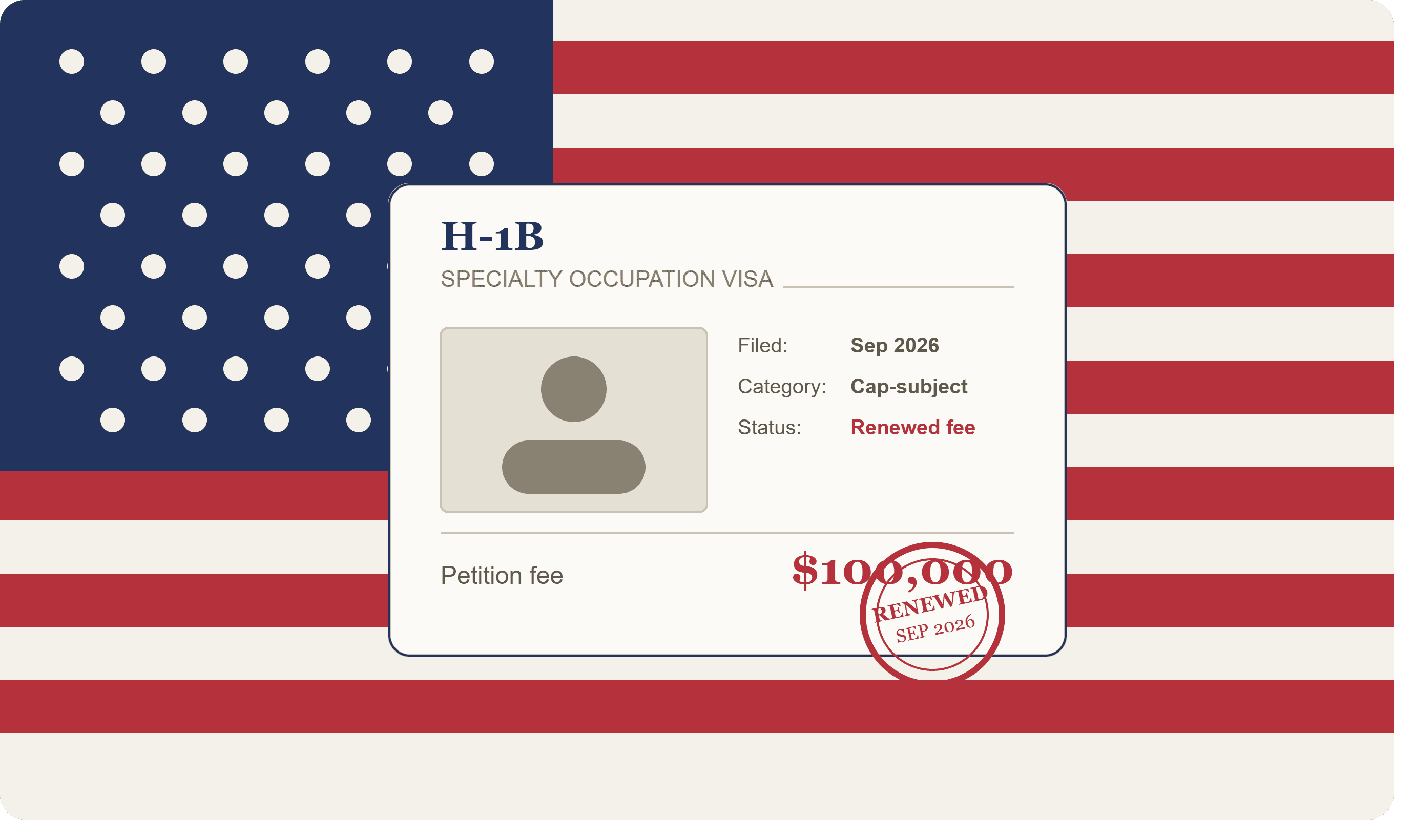
Washington — President Donald Trump signed a new Executive Order and a Proclamation on Thursday, September 18, 2026, further tightening the H-1B visa program — exactly one year after his original H-1B crackdown began.
What the new actions do
The Executive Order is aimed at strengthening "program integrity" by improving coordination between federal agencies that oversee H-1B visas:
- It directs the Secretaries of State, Labor, and Homeland Security to consult with the Secretaries of Commerce and Education, and the Small Business Administration, to gather additional data on wages, industry conditions, and job specialization tied to H-1B filings.
- Crucially, it directs those agencies to factor in an employer's recent or planned layoffs of similarly situated U.S. workers when reviewing that employer's H-1B petitions — meaning companies that have cut American jobs could face added scrutiny, or denial, when trying to bring in H-1B workers.
The Proclamation renews the $100,000 fee requirement on certain H-1B visa applications that was first imposed on September 19, 2025, and was due to lapse around its one-year anniversary.
The administration's stated rationale
According to the White House fact sheet, the original 2025 fee has already had a dramatic effect:
- H-1B registrations filed by the largest IT outsourcing firms have fallen 92% since the fee took effect.
- Consular processing requests for H-1B visas have dropped nearly 97%.
- The administration says the changes have shifted hiring "from lower-paid foreign labor toward higher-skilled and higher-wage workers."
The White House also cited earlier data showing computer science and computer engineering graduates faced unemployment rates of 6.1% and 7.5% respectively — more than double the rate for biology or art history majors — before the original proclamation, and noted that H-1B visas accounted for over 65% of IT hiring in recent years, up from 32% in FY2003.
Context: a year of escalating H-1B changes
- September 2025: The original $100,000 fee proclamation was signed.
- December 2025: USCIS finalized a rule replacing the H-1B random lottery with a wage-weighted selection system, effective for the FY2027 cap season — registrations for that cycle dropped nearly 40%.
- June 2026: A federal judge in Massachusetts struck down the $100,000 fee as an unlawful tax; the administration appealed, and the First Circuit denied a stay in July 2026.
- August 2026: DHS separately proposed an additional $103,265 fee on cap-subject H-1B petitions (a distinct regulatory proposal, still open for public comment through September 24, 2026).
- September 18, 2026: Trump's new Executive Order and Proclamation renew the $100,000 fee and add the layoff-scrutiny requirement.
What it means for Telugu tech professionals
With Telugu-speaking engineers making up a significant share of the Indian H-1B workforce, this latest action signals that Washington's tightening of the program is not temporary — it is being formally renewed and expanded, even as it remains under legal challenge. Employers with any recent U.S. layoffs may now find it harder to sponsor new H-1B hires, and the compounding effect of the wage-weighted lottery, the renewed $100,000 fee, and the still-pending $103,265 proposal means prospective H-1B applicants and their employers face a considerably more expensive and uncertain path than just two years ago.
What's still unresolved: The legal fight over the $100,000 fee's validity is ongoing at the First Circuit Court of Appeals, and it's unclear how the new Proclamation interacts with that pending litigation. Further updates are expected in the coming weeks.