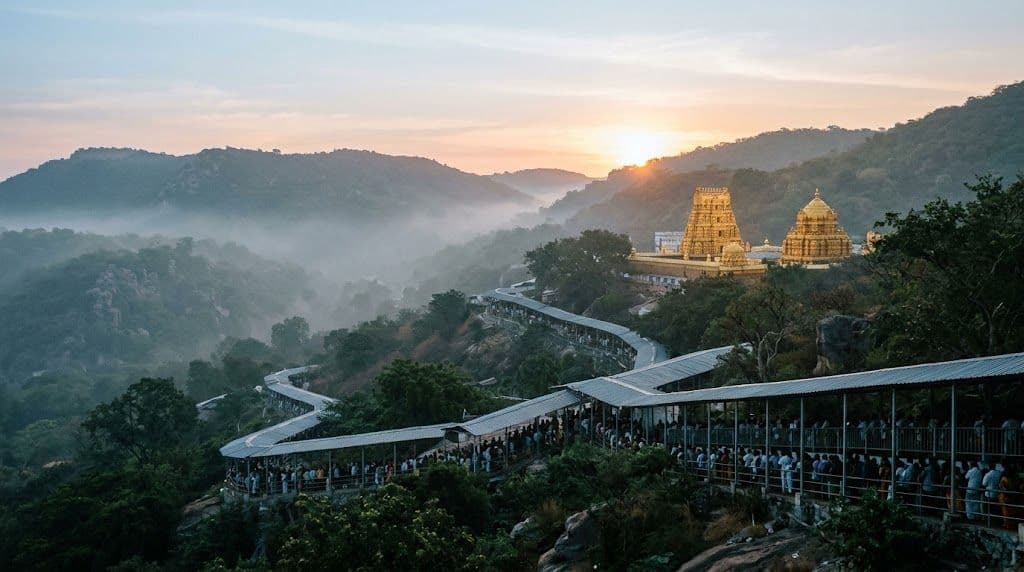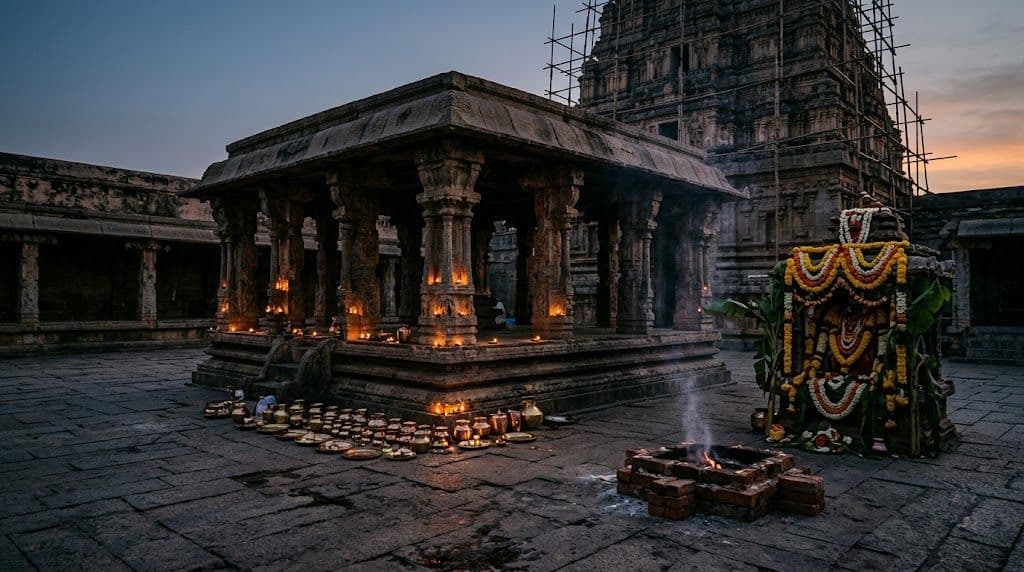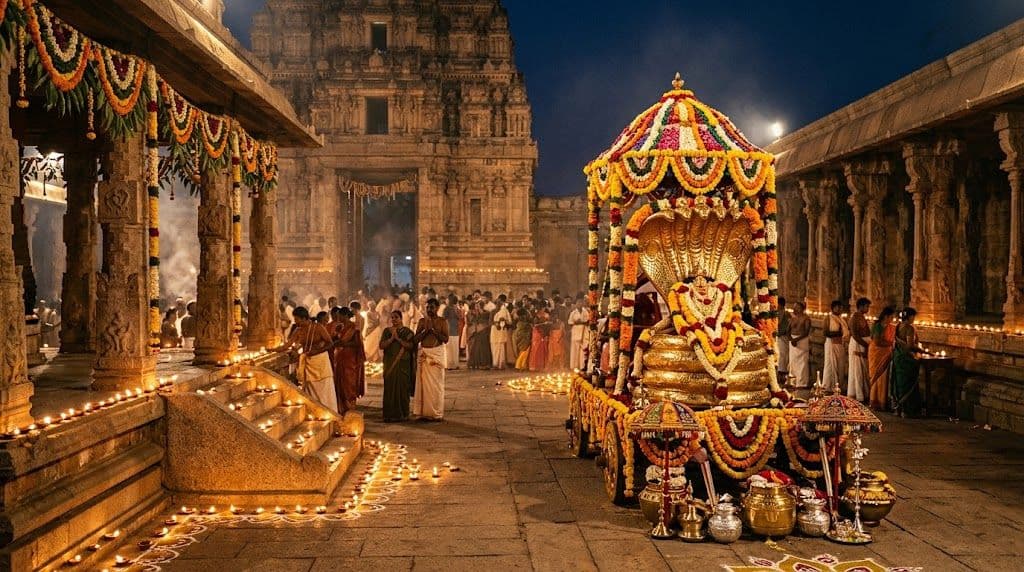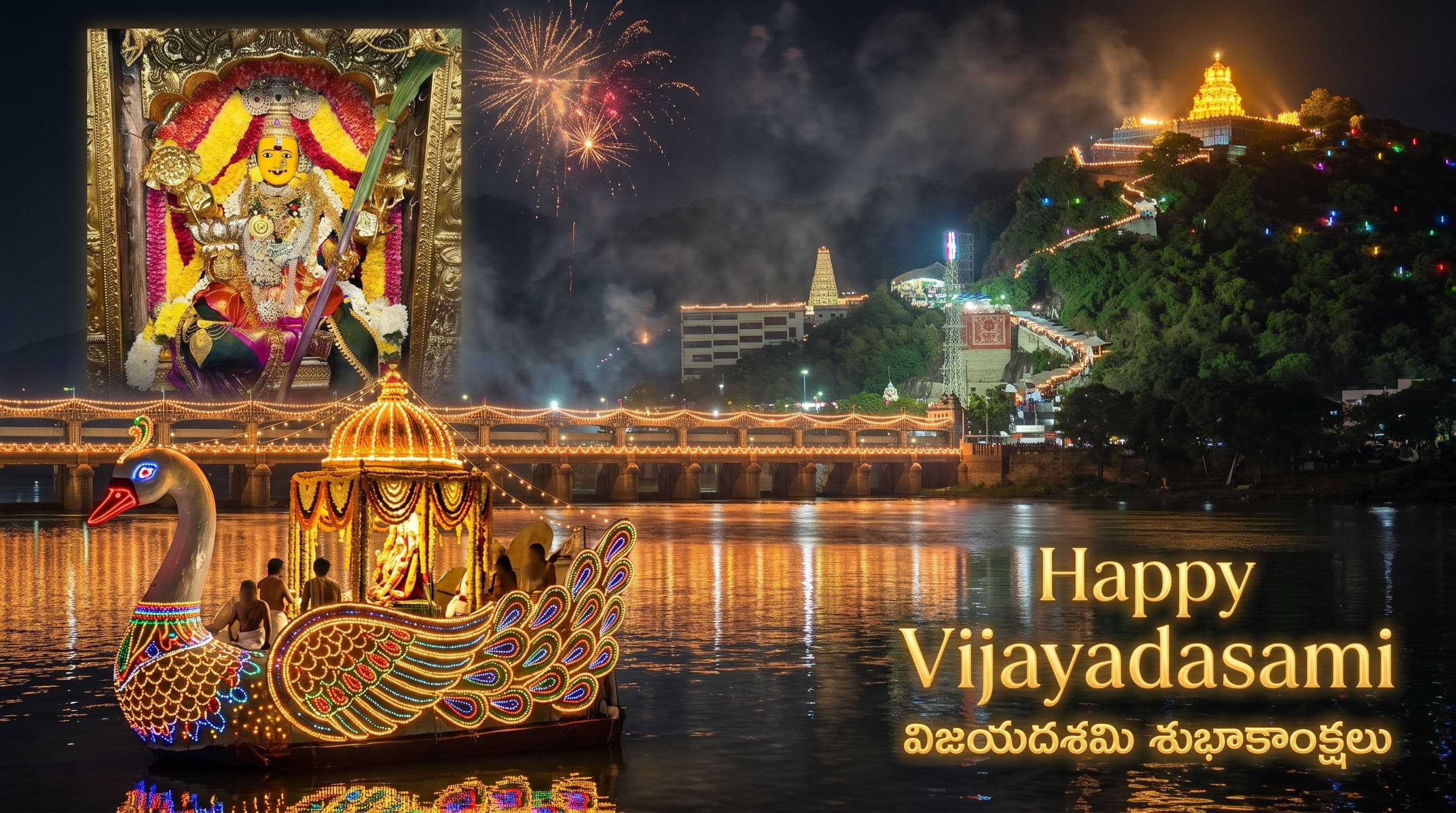
This Tuesday, October 20, is Vijayadasami. Nine nights of Sharannavaratri have run their course, and on the tenth morning the Telugu land is bright with festival again. Queues wind up Indrakeeladri for a glimpse of Kanaka Durga. Families gather at the Jammi tree on the edge of the village. Eyes search the sky for the Palapitta, whose sighting is said to bless the year. Tools and vehicles are garlanded for Ayudha Puja. These are scenes we have known for generations.
And yet this year the word "victory" does not come easily. The war in Ukraine has entered its fifth year. The war in West Asia has crossed oceans to reach the gas stove in an Indian kitchen. Every side proclaims that it is winning, and as always the common person pays. What does it mean to hold a festival of victory in such a world? What is victory, really? Events that took place ages ago have already answered it. Our elders called the Ramayana and the Mahabharata Itihasa — "iti ha asa," "thus indeed it happened." They are not tales born of imagination; they are the history of this land.
Three events, three victories
Rama and Ravana
Ravana, as the sage Valmiki records him in the Ramayana, was no ordinary adversary. He was learned in the Vedas, a devoted worshipper of Shiva, master of a golden Lanka. What destroyed him was not an enemy's arrow but his own arrogance. When Ravana came to him with the plan to abduct Sita, Maricha warned him:
Ramo vigrahavan dharmah, sadhuh satya-parakramah
Raja sarvasya lokasya, devanam iva Vasavah
— Valmiki Ramayana, Aranya Kanda
"Rama is dharma in human form — righteous, his valour rooted in truth. He is king of the whole world, as Indra is king of the gods."
The words came from a demon, and they were true. Ravana brushed them aside. Later, when his brother Vibhishana stood up in open court to counsel him, he would not listen either; he drove him out. The lesson the Ramayana leaves us is plain: power that cannot bear good counsel will fall, however mighty it seems. Rama's victory was not one strength overpowering another. It was dharma prevailing over arrogance.
 The Hazara Rama temple at Hampi (15th century). Its inner walls tell the Ramayana; its outer wall, seen here, is carved with the Mahanavami (Dasara) processions of the Vijayanagara court. Photo: Ms Sarah Welch / Wikimedia Commons (CC BY-SA 4.0)
Durga and Mahishasura
As the Devi Mahatmyam (Durga Saptashati) of the Markandeya Purana records that great battle, Mahishasura changed shape again and again — a buffalo, a lion, a man with a sword, an elephant. The Goddess triumphed by seeing through every disguise to the demon beneath. And see how the gods praised the Mother who had just fought so fiercely:
Ya devi sarvabhuteshu shanti-rupena samsthita
Namas tasyai namas tasyai namas tasyai namo namah
— Devi Mahatmyam, Chapter 5
"To the Goddess who dwells in all beings in the form of peace — salutations to her, salutations, salutations again and again."
The very Mother who struck down the demon on the battlefield is hailed as Peace itself. Her war, this hymn tells us, was waged to restore peace. On Indrakeeladri in Vijayawada, the self-manifested Kanaka Durga is worshipped as Mahishasura Mardini, the Telugu land's living witness to that divine event. Hers is the victory of truth over illusion.
 The 7th-century Pallava relief in the Mahishasuramardini Mandapa at Mahabalipuram: the Goddess, riding her lion, in battle with Mahishasura. Photo: Wikimedia Commons
The Pandavas and the Jammi tree
Before entering their year in hiding, the Pandavas concealed their weapons in a Shami — our Jammi — tree outside King Virata's city. When the exile ended, Arjuna took down the Gandiva from that very tree and faced the Kaurava army almost alone in the cattle-raid of Uttara Gograhanam. In Telugu, this episode was rendered into enduring verse by Tikkana Somayaji, the "Kavibrahma," whose share of the Andhra Mahabharatam begins with the Virata Parva. That is why, on Dasara, we walk around the Jammi tree and recite:
Shami shamayate papam, Shami shatru vinashini
Arjunasya dhanurdhari, Ramasya priyadarshini
"The Shami quiets sin and destroys the enemy; it held Arjuna's bow and was dear to Rama." Our custom of giving Jammi leaves as "bangaram," gold, while seeking the blessings of elders comes from here. But there is a subtler point worth noticing. The greatness of the Pandavas lay not in taking up arms but in being able not to. The Gandiva was within reach, and they left it in the tree until dharma permitted. That restraint was their victory.
What history remembers
Our history, too, has tied this festival both to royal splendour and to soul-searching. In the Vijayanagara empire, the king watched the Navaratri festivities from the great stone platform at Hampi now called the Mahanavami Dibba; the Portuguese traveller Domingo Paes, who came in the time of Sri Krishnadevaraya, described the spectacle with open astonishment. The empire fell, but the tradition did not. In 1610 the Wodeyars carried it on at Srirangapatna, and today's Mysuru Dasara is its living heir.
 The Mahanavami Dibba at Hampi, from which the Vijayanagara kings watched the Navaratri festivities. Photo: Wikimedia Commons
Yo sahassam sahassena, sangame manuse jine
Ekan ca jeyyam attanam, sa ve sangamajuttamo
— Dhammapada, 103
"Though one conquer a thousand times a thousand men in battle, he who conquers himself is the greatest of victors."
The deepest meaning history has given Vijayadasami lies in exactly these words of the Buddha. Ashoka had conquered multitudes at Kalinga; then, seeing the rivers of blood, he set out to conquer himself, laying down the sword and turning to dhamma. Buddhist tradition remembers that turning point on Vijayadasami. Honouring that memory, on October 14, 1956 — Ashoka Vijayadashami that year — Dr B.R. Ambedkar embraced Buddhism at Deekshabhoomi in Nagpur along with lakhs of followers. An emperor and the architect of our Constitution, centuries apart, chose this day not to conquer others but to win the "greatest of victories" the Dhammapada speaks of.
 The Deekshabhoomi stupa in Nagpur, where Dr B.R. Ambedkar embraced Buddhism on Vijayadasami, 1956. Photo: Wikimedia Commons
The real battles of 2026: today's Ravana and his ten heads
Victories and defeats on the battlefield make the front page. But the battles that most need winning are fought around us, and within us. Our elders taught that Ravana's ten heads carry the lesson of ten vices. Seen in that light, here are the ten heads troubling the world and our country this Dasara — ten battles we must win.
Krodhad bhavati sammohah, sammohat smriti-vibhramah
Smriti-bhramshad buddhi-nasho, buddhi-nashat pranashyati
— Bhagavad Gita, 2.63
"From anger comes delusion; from delusion, the confusion of memory; from that confusion, the ruin of judgement; and from the ruin of judgement, one perishes."
The Gita's ladder of downfall is worth noticing: vices never arrive alone, they come in a chain, one pulling the next. Ravana's ten heads were not separate creatures; they sat on a single neck. The same chain runs through the ten heads that follow. War exposes dependence, dependence drives up prices, and the fear of rising prices breathes life into rumour.
 Effigies of Ravana, Kumbhakarna and Meghanada stand ready at Ramleela Maidan, Delhi, for the Dasara burning (2010). Photo: Wikimedia Commons
1. The appetite for war
On October 18, a Russian strike on Kyiv killed a woman and damaged a metro station. There is talk of Putin, Trump and Xi meeting to discuss peace, but for now the weapons speak louder than the words. The Iran war that began on February 28 has shaken the entire global economy. Not defeating the enemy, but defeating war itself — that is the victory this generation must achieve.
2. Dependence
When the Strait of Hormuz closes far away, the kitchen goes cold here at home. It is the bitter lesson India learned this year. Most of the cooking gas we import passes through that strait, and the queues of the spring are still fresh in memory. Even now a domestic cylinder costs ₹942 in Delhi, and the 19-kg commercial cylinder has risen ₹62.50 since September to ₹2,810. Just as the Pandavas stored their strength in the Jammi tree for a hard season, the strength a nation must store is self-reliance.
3. Falsehood
Satyameva jayate nanritam, satyena pantha vitato devayanah
— Mundaka Upanishad, 3.1.6
"Truth alone triumphs, not falsehood; by truth is laid the path to the divine."
These are the words carved beneath our national emblem. But truth does not win on its own; it needs people who will recognise it and stand by it. Like Mahishasura, a lie keeps changing its costume — a WhatsApp message one day, a clipped and stitched video the next, an AI-generated image after that. During this year's fuel crisis, rumours of shortage spread more fear than the shortage itself. Pausing for a moment to check the truth before sharing anything is the Mahishasura Mardana of our age.
4. Fraud
Earlier this month, Andhravani reported on young men from Telangana lured by agents with promises of "good jobs abroad," only to find themselves near the Russian front. Deception, like Maricha in the guise of the golden deer, always arrives glittering. Any overseas job offer should be checked through eMigrate and the official channels of the Ministry of External Affairs.
5. Negligence
Sarve bhavantu sukhinah, sarve santu niramayah
Sarve bhadrani pashyantu, ma kashchid duhkha-bhag bhavet
— Shanti mantra
"May all be happy, may all be free from illness, may all see what is good, may no one suffer."
In this prayer we have recited for generations, "all" was never limited to our own village or our own country. The Ebola outbreak that surfaced in Congo in May has become the worst in that country's history: 8,463 cases and 4,082 deaths as of October 2, according to WHO figures. There is still no vaccine for this Bundibugyo strain, and Kenya has already confirmed three cases. Covid taught us one thing above all: epidemics recognise no borders, and vigilance gets no holiday. Praying "sarve santu niramayah" is easy; vigilance is what turns that prayer into practice.
6. The weight of prices
Fuel, fertiliser, freight — a crisis that began in a single strait has pushed up prices across the world. In France, protests over the cost of living have turned violent. In India, small hotels, tiffin carts and middle-class households carry the weight in silence. History has never forgiven a government deaf to the common person's grievance, whether in Lanka or anywhere else.
7. Intoxication
Last Dasara, Punjab Police in Jalandhar burnt an effigy of the "demon of drugs." Ganja and other narcotics are devouring young people in the Telugu states as well. This is Kumbhakarna's sleep: by the time a society wakes, it may be too late.
8. Hatred
Ayam nijah paro veti ganana laghu-chetasam
Udara-charitanam tu vasudhaiva kutumbakam
— Maha Upanishad
"'This one is mine, that one a stranger' — such reckoning belongs to the narrow-minded. For the large-hearted, the whole earth is one family."
Today there is no end to that reckoning of "mine" and "stranger." Caste, religion, region, party, favourite film star — on social media everything becomes a battlefield. Hyderabad's Alai Balai tradition asks us to set old quarrels aside on Dasara and embrace. Ours is a festival of pressing a Jammi leaf into someone's hand and calling them "bangaram," not one for trading hate.
9. Arrogance
Dambho darpo'bhimanash cha krodhah parushyam eva cha
Ajnanam chabhijatasya partha sampadam asurim
— Bhagavad Gita, 16.4
"Hypocrisy, pride, conceit, anger, harshness and ignorance — these, O Partha, are the endowment of one born to the demonic nature."
Every item in the Gita's inventory of demonic wealth was present in Ravana in full. And "ignorance" here does not mean lack of learning — Ravana knew the Vedas and was ignorant still. He did not fall for lack of knowledge; he fell because he could not bear advice. Heads of state, heads of companies, heads of households — whenever they lack the humility to hear their Vibhishana, Lanka burns.
10. Indifference — the head within us
Niyatam kuru karma tvam karma jyayo hy akarmanah
Sharira-yatrapi cha te na prasiddhyed akarmanah
— Bhagavad Gita, 3.8
"Do your appointed duty, for action is better than inaction; without action, even the journey of your body could not go on."
Krishna said this to an Arjuna who had let his bow slip and declared, "I will not fight." Many of us today stand where Arjuna stood. The most dangerous head of all is the shrug that says "why should I care?" Not voting. Staying silent when injustice happens before our eyes. Ceasing to ask questions. Rama had an army of vanaras beside him; even a small squirrel carried grains of sand for the bridge to Lanka. Victory over evil has never come from one person alone. It has always come from all of us.
Dasara in Telugu homes
In Vijayawada, through the Sharannavaratri from October 11 to 20, Kanaka Durga blessed devotees in a different alankaram each day; on the evening of Vijayadasami, the Theppotsavam carries Durga and Malleswara on a swan-shaped float across the Krishna, a sight to fill the eyes. In Telangana, Dasara follows close on the heels of Bathukamma, the festival of flowers, and its heart is the Jammi puja and the sighting of the Palapitta. That the Jammi is Telangana's state tree and the Palapitta its state bird is no accident; it is the state honouring what its people hold sacred.
 Bathukammas stacked high with flowers. Photo: Wikimedia Commons
 The Palapitta (Indian roller), Telangana's state bird; a sighting on Dasara is considered auspicious. Photo: Koshyk / Wikimedia Commons (CC BY 2.0)
Not so long ago, schoolchildren went from house to house with their teacher singing Dasara verses — "a few coins are plenty for the teacher, dal and jaggery are plenty for the children." That custom has all but vanished, but the respect for the guru behind it is an inheritance our children deserve. And from London and Toronto to Muscat and Dallas, the Telugu diaspora gathers on weekends to celebrate Bathukamma and Dasara, quietly declaring that distance has not loosened their roots.
Muhurtham: Dashami tithi begins around 12:50 PM on October 20 and lasts until about 2:11 PM on October 21. The Vijaya Muhurtham falls roughly between 2:00 PM and 2:46 PM IST. Timings shift by a few minutes from city to city, so it is best to consult your local panchangam.
Victories without weapons
Amid the news of war, this year has also offered victories that lift the heart. At the Aichi-Nagoya Asian Games, which ended on October 4, India finished fourth with 85 medals — 21 gold, 27 silver and 37 bronze. Both the men's and the women's hockey teams won gold at the same Games. Seventeen-year-old archer Kumkum Mohod won three medals, two of them gold, and brought an end to South Korea's long dominance of women's recurve archery.
Pause on that for a moment. In the very season that remembers Arjuna's bow coming down from the Jammi tree, a young Indian woman drew her bow and won gold without taking a single life. A victory that ends with a handshake across the field — that is exactly the kind of victory this world now needs.
The true meaning of victory
Rama taught us the victory of dharma over arrogance. Durga taught us the victory of truth over illusion. The Pandavas taught us the victory of patience over impulse. Ashoka taught us the victory of compassion over the sword. Notice that not one of these victories is about destroying someone else.
On Vijayadasami, kings once crossed the borders of their kingdoms to set out on campaign, a rite called Seemollanghanam. The borders we must cross today are of another kind — the border of our fears, of our complacency, of our hatred. In a world crowded with wars, true victory does not lie in defeating the other. It lies in defeating the Ravana within. Setting fire to an effigy in the maidan is easy. The day we conquer the Ravana inside us is the true Vijayadasami.
Andhravani wishes all its readers a happy Vijayadasami. Ya devi sarvabhuteshu shanti-rupena samsthita — may the Mother dwell in every heart as peace.
What does victory mean to you in 2026? Which of these ten battles should we win first? Share your thoughts with us.