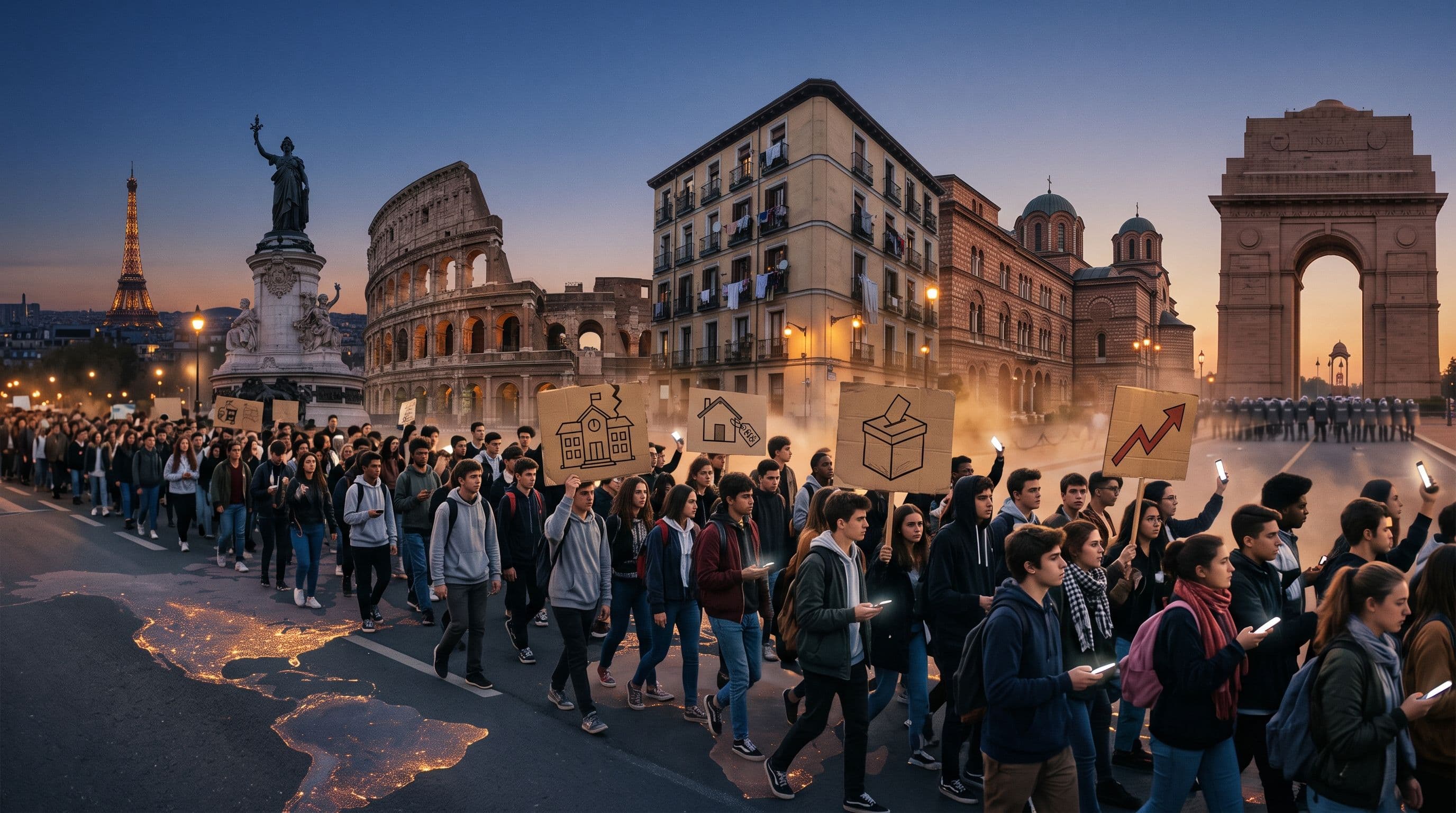
On Saturday, France had one of its biggest protest days in years. Interior Minister Laurent Nuñez put the turnout at around 550,000 nationwide, 110,000 of them in Paris. Organisers claimed 800,000. Limoges city hall was set on fire, a tourist office burned in Lyon, and around 400 people were arrested. Prime Minister Sébastien Lecornu blamed far-left groups and looters for the violence and said France "will not be intimidated."
Behind the tear gas, a bigger story is unfolding. A protest about schools has run into a debt crisis, a presidential election and a global youth revolt, all at the same time.
How a school protest became a national revolt
It started in mid-September, when high school students blockaded their own schools over leaking roofs, overcrowded classrooms and missing teachers. By early October, 400 to 500 schools were partly or fully shut. University students, teachers' unions, parents, the CGT union, farmers, taxi drivers and veterans of the 2018 "yellow vest" movement have since joined. The government's offers so far include 3,000 substitute teachers, a ban on one type of police grenade, and an online platform where 66,000 students have voiced their grievances. Students have called these insufficient. Unions have already called a general mobilisation for November 5.
The human cost is real. According to the Justice Ministry, thousands have been placed in custody, most of them minors. In Lens, a 15-year-old lost his hand when a grenade exploded near his school.
The money problem nobody can escape
The students want more money for schools. France has very little to spare. Public debt is above €3.5 trillion, about 115% of GDP, and the deficit is projected at 5.4% this year. Investors have noticed: the gap between French and German borrowing costs is the widest since 2012. Economists warn that a French debt scare could spread across the eurozone, much as Greece's did in the early 2010s.
That is the trap. Every euro for schools needs a vote in a divided parliament, and every sign of instability pushes borrowing costs higher, which leaves even less money for schools.
The politics: a gift to the extremes
Emmanuel Macron cannot run again, and France votes for a new president in April 2027. Polls already show Marine Le Pen leading the first round with roughly a third of the vote, with the hard-left Jean-Luc Mélenchon second in most scenarios. Analysts say the protests have boosted Mélenchon among young voters. The government accuses his party of exploiting the students, while his party accuses the government of repression. The centre, meanwhile, is getting squeezed from both sides.
Europe catches the fever
- Belgium: Student protests over education costs led to riots in Liège and more than 130 arrests. On Saturday, a car was overturned in Brussels.
- Italy: Students occupied schools in Turin and Rome under the slogan "Let's do as in France" and sent a delegation to Paris.
- Albania: Students angry about university costs and corruption set fire to the education ministry in Tirana. Their protest has joined a months-long movement against Prime Minister Edi Rama and a luxury resort project linked to Jared Kushner. Rama refuses to resign.
- Spain: An 87-year-old woman was evicted from her home of seven decades, and housing protests erupted in about 50 cities. Rents have nearly doubled in ten years, and reports suggest an early election could become a referendum on housing.
The global wave
None of this is isolated. The Carnegie Endowment counted at least 120 significant anti-government protests in more than 70 countries in the year to March 2026, the highest number since 2017. Youth-led uprisings have shaken Kenya, Indonesia, Madagascar, Peru and Morocco. Nepal shows how far it can go. Gen Z protests toppled the government there in September 2025, at a cost of at least 77 lives. Six months later, voters handed a landslide to the party of Balendra Shah, a 35-year-old former rapper and Kathmandu mayor.
India's version
India has its own movement. In May, the Chief Justice of India compared some unemployed youth to cockroaches; he later clarified that he meant people holding fake degrees. Within a day, an online satire called the "Cockroach Janta Party" was born. It grew on anger over repeated exam paper leaks, and the then education minister, Dharmendra Pradhan, resigned. The government has since backed tougher penalties for leaks and set up a panel to review the exam system. The movement has now turned to demanding that Chief Election Commissioner Gyanesh Kumar resign over voter-list revisions. Delhi Police have removed Jantar Mantar from the list of designated protest sites and detained founder Abhijeet Dipke more than once.
The economic backdrop is familiar. Official data for 2025 put unemployment among Indians aged 15 to 29 at 9.9%, and at 13.6% among urban youth.
Where this is heading: Andhravani's analysis
- France will not get a quick fix. The state cannot afford what students are asking for, and markets will punish it if it tries. The most likely path is partial concessions, protests flaring around the budget votes and the November 5 union day, and then the anger flowing into the presidential campaign. The biggest winners are likely to be the candidates at the extremes.
- Bond markets are the hidden player. If unrest delays France's budget, borrowing costs rise and the money for schools shrinks further. Watch the French-German spread. If it keeps widening, this becomes a European problem, not just a French one.
- The contagion will continue, but each country will have its own trigger. Schools in Belgium and Italy, housing in Spain, corruption in Albania. The movements share a playbook and an online feed, not a single leader.
- From the street to the ballot box is the new playbook. Nepal proved that a youth movement can turn into votes. Expect more young candidates, new parties and protest-born campaigns in the elections of 2027. Movements that stay leaderless and turn violent tend to be crushed or hijacked.
- Governments will keep shrinking the space for protest. Designated sites, preventive detentions, mass custody and account takeovers are spreading. Shrinking that space rarely calms anger. More often, it pushes it somewhere less predictable.
What it means for Telugu families
Europe is one of the biggest markets for Hyderabad's IT and pharma companies. A eurozone debt scare would be felt in Hitec City long before it is felt in Paris cafés. Thousands of Telugu students study in France, Germany and Italy, and their safety and visa timelines are directly affected. At home, the grievances driving these protests, exam leaks, joblessness and costly education, are ones that every aspirant in Hyderabad's coaching centres already knows by heart.
Andhravani's view
Burning city halls and banks is not protest. It is destruction, and it hands every government an excuse to stop listening. Movements that want to win must control the violence at their own edges.
But governments should count the marchers, not just the arrests. When hundreds of thousands of teenagers take to the streets, that is not a law-and-order problem. It is a failure of policy. Tear gas can clear a square. It cannot fix a school, lower a rent or restore trust in an election. The leaders who listen now are the ones who will not have to answer to the street later.
For Telugu students in Europe: avoid protest areas, keep your university and Indian embassy contacts handy, and follow local advisories.