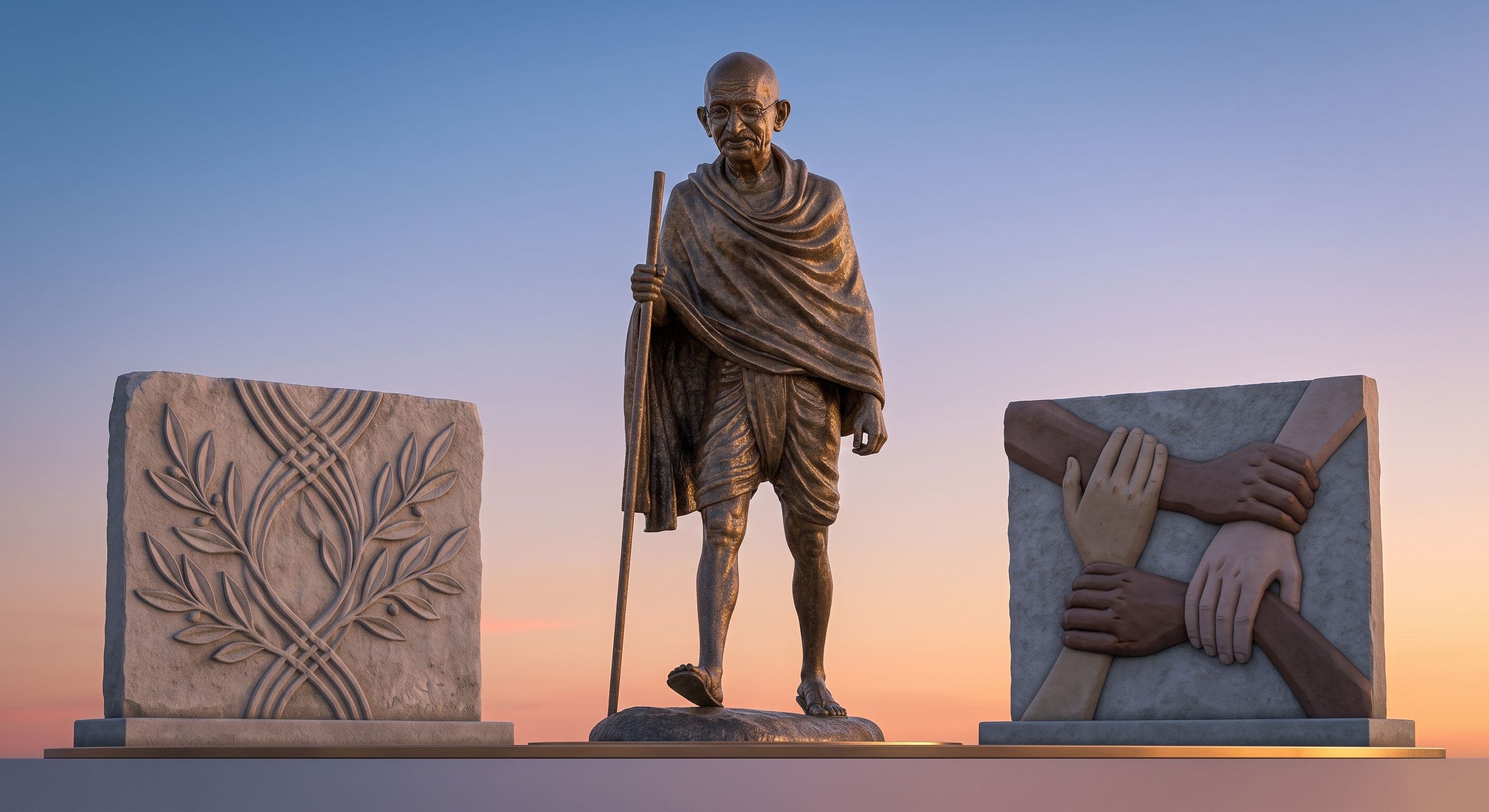
New Delhi — Every October 2, India pauses to remember Mohandas Karamchand Gandhi — the man who led a nation to freedom not through the barrel of a gun, but through satyagraha, the force of truth. More than 75 years after his death, and on this Gandhi Jayanti, it's worth asking a harder question than usual: is the world actually moving toward the peace he envisioned, or further away from it?
A world of fragile ceasefires, not peace
Several of today's deadliest conflicts are technically paused rather than resolved. In Gaza, a ceasefire brokered in October 2025 has held in name, but sporadic Israeli strikes have continued to kill Palestinians, and reconstruction of the devastated territory remains stalled. In Ukraine, a ceasefire along existing front lines has effectively frozen the conflict while leaving Russia in control of territory it seized — a outcome analysts describe as a "way station," not a genuine peace accord. Meanwhile, war continues largely unchecked in Sudan, displacing millions with far less global attention than other conflicts receive.
Gandhi did not believe peace could be built on the management of violence — he insisted it had to be built on its renunciation. Judged by that standard, 2026's "peace deals" look less like the Gandhian ideal and more like exhausted parties pausing to regroup.
Rising walls, not bridges
Gandhi's vision extended beyond the absence of war to a world of interdependence and shared welfare — what he called sarvodaya, the welfare of all. Yet 2026 has been a year of walls going up rather than coming down: sharply escalating tariffs between major economies, tightening immigration restrictions in the United States and elsewhere, and a general retreat from the kind of international cooperation that marked earlier decades. Even skilled migration — long framed as a mutually beneficial exchange — has become a flashpoint for nationalist politics in multiple countries.
This drift toward economic and cultural isolationism sits uneasily with Gandhi's belief that "no culture can live if it attempts to be exclusive."
India's own balancing act
At home, India continues to present itself as a voice for peaceful dialogue on the world stage — welcoming ceasefire efforts in Gaza and elsewhere, and positioning itself as a bridge between competing global blocs. But Gandhi's vision of peace was never only about foreign policy; it was rooted in how a society treats its own people. Communal harmony, economic justice for the poorest, and non-violent resolution of internal disputes remain unfinished work, as they have been in every decade since independence. Gandhi Jayanti is as much a mirror turned inward as it is a lens on the world.
Where the hope lies
It isn't all bleak. The fact that ceasefires exist at all in Gaza and Ukraine — however fragile — reflects continued belief that negotiated settlements are preferable to endless war, a principle Gandhi would have recognized even if the execution falls short of his ideals. Diplomatic channels, however imperfect, remain open. International humanitarian institutions, though strained, continue to operate. These are not nothing.
Gandhi himself never expected perfection — his philosophy was built around continuous striving, not a finished destination. "Non-violence is a weapon of the strong," he said, aware that the path would be slow and often reversed. Measured against that long arc rather than any single year's headlines, 2026 is neither proof that Gandhi's vision has triumphed, nor that it has failed — only that the work he started remains, nearly eight decades later, urgently unfinished.
This Gandhi Jayanti, as Andhravani joins the nation in remembering the Mahatma, it is worth asking not just what the world owes Gandhi's memory, but what each of us owes the unfinished work of peace he left behind.