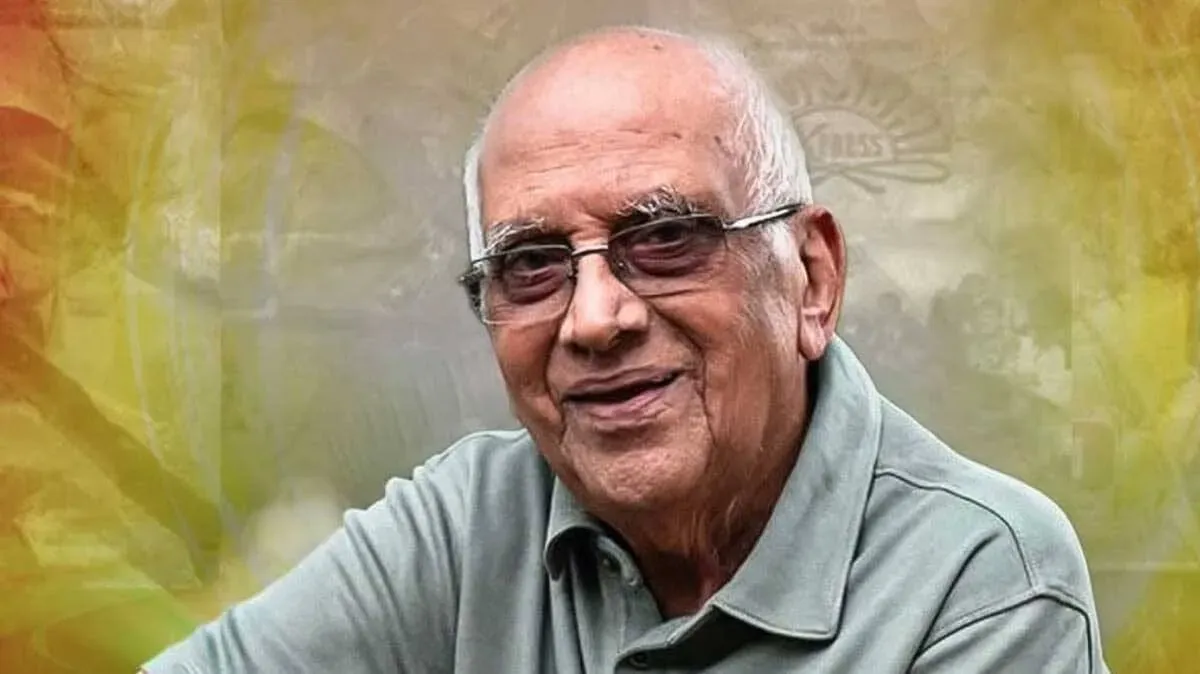
Chennai — Veteran filmmaker, screenwriter, producer, and composer Singeetham Srinivasa Rao passed away on Saturday, October 3, 2026, at Kauvery Hospital in Chennai, where he had been undergoing treatment for age-related ailments. He was 94.
Widely regarded as one of Indian cinema's most versatile and fearless storytellers, Singeetham built a career spanning more than six decades across Telugu, Tamil, Kannada, Malayalam, Hindi, and even English-language cinema, directing around 60 feature films in total — an output that very few filmmakers of his generation could match in sheer range.
From a headmaster's son to K.V. Reddy's protégé
Born on September 21, 1931, in Gudur in the then-Madras Presidency, Singeetham grew up in a household shaped by both discipline and art — his father, Ramachandra Rao, was a headmaster, while his mother, Sakunthala Bai, was a violinist. After his education at the University of Madras, he found his way into the film industry as an assistant to the legendary K.V. Reddy, working behind the scenes on era-defining classics such as "Mayabazar" and "Jagadeka Veeruni Katha." It was an apprenticeship under one of Telugu cinema's most meticulous craftsmen — a grounding that would later surface in Singeetham's own obsessive attention to structure and detail, even as he pushed far beyond convention.
He made his own directorial debut in 1972 with "Neeti Nijayiti," an offbeat Telugu film that signaled, from the very start, a filmmaker uninterested in following the crowd.
A career defined by refusing to repeat himself
What truly set Singeetham apart was not just talent, but restless curiosity — a refusal to make the same film twice. Across his career he moved effortlessly between comedy, mythology, fantasy, science fiction, folklore, social drama, and even silent cinema, often introducing ideas that were years ahead of Indian filmmaking at the time.
"Aditya 369" (1991) introduced mainstream Telugu audiences to time travel as a cinematic device, wrapping serious science-fiction ideas inside a thoroughly entertaining package. "Pushpaka Vimanam" (1987) was even bolder: a feature-length comedy with not a single line of spoken dialogue, relying entirely on physical performance and visual storytelling — a format almost unheard of in commercial Indian cinema, then or now. "Bhairava Dweepam" (1994) stood as a landmark fantasy-folklore film, earning him the Nandi Award for Best Director, while "Mayuri" (1985), a dance drama inspired by a true story, became a cultural phenomenon, sweeping a record 14 Nandi Awards including Best Feature Film.
His versatility extended well beyond Telugu cinema. He made his Kannada directorial debut with the 1982 blockbuster "Haalu Jenu," starring the iconic Rajkumar, beginning a deep creative partnership between the two — one built on such mutual trust that when Rajkumar briefly stepped away from acting in 1988, Singeetham simply turned his restless energy toward other languages and genres rather than slowing down. In Tamil and Hindi, his collaborations with Kamal Haasan produced two of the era's most memorable comedies, "Apoorva Sagodharargal" (1989) and "Michael Madana Kama Rajan" (1990), both showcasing his gift for intricate, high-concept comic storytelling. In Telugu, he also found a recurring creative partner in Nandamuri Balakrishna, directing him in "Aditya 369," "Bhairava Dweepam," and the mythological "Sri Krishnarjuna Vijayam" (1996).
A relentless, inspiring curiosity that never aged
Perhaps the most remarkable chapter of Singeetham's story is its final one. Rather than easing into retirement, he announced in February 2026 — at the age of 94 — his return to the director's chair with a project provisionally titled "SSR61," his first film in a decade. That project became "Singeetham," produced by Nag Ashwin, and stands as his final directorial work. For a filmmaker in his mid-nineties to still be dreaming up new stories, assembling a crew, and shaping a film shot by shot is a testament rarely matched in world cinema — and it is precisely this refusal to stop creating that colleagues and admirers have pointed to as the most inspiring part of his legacy.
Over his lifetime, Singeetham was honored with two National Film Awards, five Nandi Awards, three Karnataka State Film Awards, and three Filmfare Awards South, along with the Film Federation of India's Life Achievement Award in 2011 and a special biography published in his honor by the Kannada Film Journalists Association. "Pushpaka Vimanam" alone won the National Film Award for Best Popular Film Providing Wholesome Entertainment — a rare recognition for a film with no dialogue at all.
Tributes and a legacy that keeps teaching
News of his passing drew an outpouring of tributes from across the film industry and political leadership, including actor Jr NTR, who paid homage to the filmmaker's decades of contribution to Indian cinema. For generations of filmmakers who followed him, Singeetham's career offers an enduring lesson: that genuine originality — the willingness to attempt what hasn't been tried, in a dialogue-less comedy or a time-travel saga decades before it became fashionable — rarely goes out of style, and that creative curiosity, once nurtured, need never fade with age.