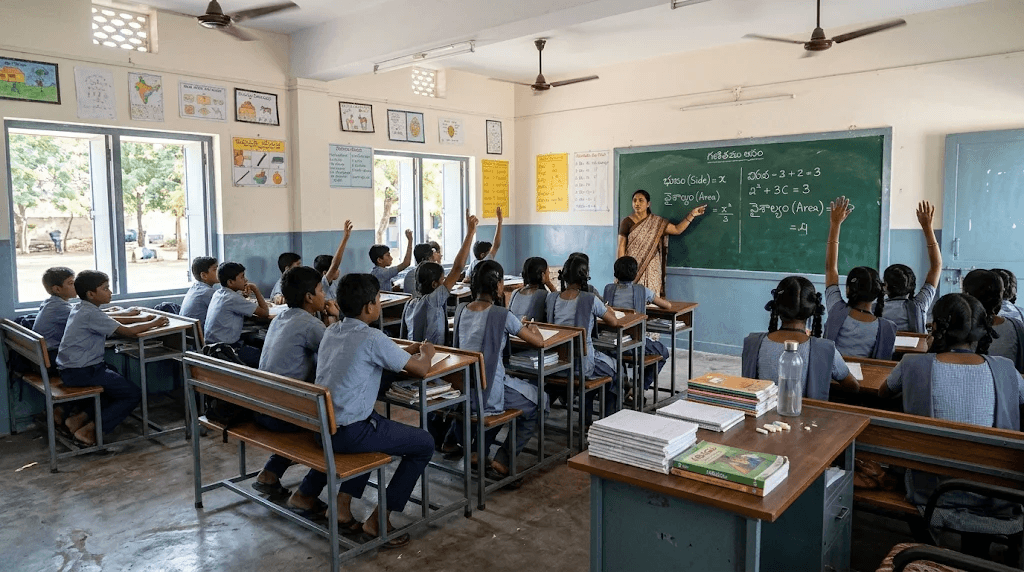
HYDERABAD: A UNESCO education report released in Hyderabad on Friday points to a Warangal classroom as evidence that children learn better in a language they know. When a Class VII maths teacher used Telugu alongside English, student participation rose from 10% to over 70%. School Education Director E. Naveen Nicolas released 'Bhasha Matters: State of the Education Report for India 2025' at a programme held by the UNESCO Regional Office for South Asia with the Telangana government.
The report is authored by Dr Minati Panda. Nicolas said its recommendations "must move beyond policy commitments towards meaningful classroom implementation." Dr Huma Masood, National Programme Officer at the UNESCO regional office, took part.
Telangana in numbers
- Warangal study: 2024-25, under the British Council's Action Research Mentoring Scheme, with partners including NIT Warangal
- 274 textbooks for Classes 1 to 10
- Eight classroom languages since 2019: Telugu, Hindi, Urdu, Kannada, Marathi, Tamil, Bengali and English
- A nine-language digital dictionary prepared by SCERT
A University of Cambridge and EFLU Hyderabad study in ten low-cost government schools found a 30% improvement in reading when students discussed English passages in different languages and answered in Telugu, Dakkhini or English. The report also notes efforts to preserve the tribal languages Lambadi, Gondi and Kolami.
UNESCO recommends a state-level policy and a national mission for mother-tongue-based multilingual education. The National Education Policy 2020 recommends teaching in the home language until at least Class 5, preferably Class 8. UNESCO first released the report in New Delhi on 16 December 2025.