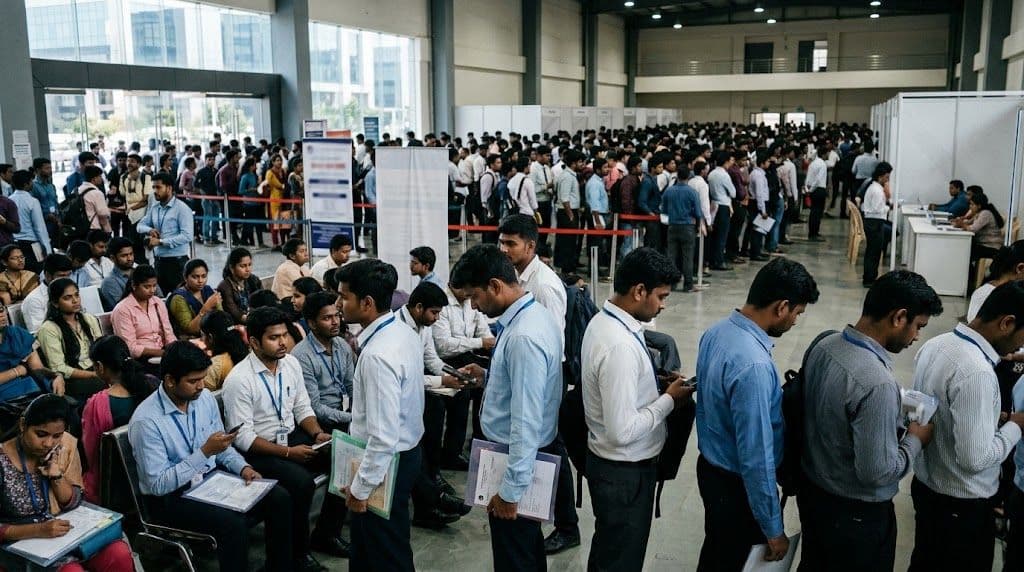
For three decades, India's IT industry has been the country's most reliable ladder into the middle class. A degree, a campus offer and a job in Hyderabad, Bengaluru or Pune could lift a whole family in one generation. That ladder is now being pulled up from the bottom. The cause is AI, and the evidence is already in the numbers.
At a glance
- −80% fall in IT campus hiring, FY22 to FY25
- −7,389 net jobs lost at the top 5 IT firms in FY26
- −29% Nifty IT index in 2026, by mid-year
- 60 lakh NITI Aayog's 2031 worst case for tech services jobs
Earning more, hiring less
NASSCOM's FY26 figures show the break clearly. India's tech industry grew revenue 6.1% to $315 billion, but its workforce grew just 2.3%, to 59.5 lakh. Net job additions were 1.35 lakh, almost unchanged from 1.33 lakh the year before. The industry added roughly $18 billion in revenue and only about 2,000 more jobs than the previous year.
Chart: Earning more, hiring less
India's tech industry, FY26 growth over FY25
- ████████████████████ +6.1% revenue growth (to $315 billion)
- ████████ +2.3% workforce growth (to 59.5 lakh)
Source: NASSCOM Strategic Review 2026
At the top it is worse. India's five biggest IT services firms (TCS, Infosys, HCLTech, Wipro and Tech Mahindra) ended FY26 with 7,389 fewer employees combined, after adding 12,718 in FY25. TCS alone went from 6,07,979 employees to 5,84,519, a net fall of 23,460.
Chart: The big five went from hiring to shedding
Net change in combined headcount at TCS, Infosys, HCLTech, Wipro and Tech Mahindra
- ████████████████████ +12,718 in FY25
- ████████████ −7,389 in FY26
Source: company filings, compiled by IANS / News18
Meanwhile, RBI data shows software services exports rose 8.2% to $221.4 billion in 2025-26. The money keeps coming. The jobs no longer follow it.
Infosys shows why. In its latest quarter, AI work made up 10.5% of its revenue and grew 29% in three months, yet the company cut its full-year growth forecast to 1–2%. The new AI work is smaller, faster and needs far fewer people than the old work it replaces.
The bottom rung is disappearing first
Chart: Campus hiring in Indian IT
Fresh graduates hired per year
- ████████████████████ ~6 lakh in FY22 (peak)
- ████ ~1.2 lakh in FY25
An 80% fall in three years.
Source: Xpheno
- 80% fall in campus hiring: Fresher hiring in Indian IT peaked at about 6 lakh in FY22 and fell to roughly 1.2 lakh by FY25, according to talent analytics firm Xpheno.
- 44% fewer entry-level openings: Tech openings for people with up to two years' experience were down 44% year-on-year in mid-2026 (Xpheno).
- Entry level takes the hit: A firm-level ICRIER study found AI adoption has slowed hiring mainly at the entry level.
- Old roles shrinking, new ones tiny: foundit's August report found fresher hiring down 10% year-on-year, while AI roles were just 4% of entry-level hiring.
The reason is simple. A large share of India's IT workforce does testing, application support, maintenance and basic coding, exactly the repeatable work AI coding tools do best. The pyramid model, where thousands of juniors supported a few seniors, is collapsing at its base. And that base is where most of our graduates enter.
The warning signs are global, and they reach India
This week, Microsoft offered voluntary exits to about 60,000 employees, roughly 27% of its 2.23 lakh workforce, across the US, Canada, the UK and India, as it cuts costs and pours money into AI. It is the company's second buyout offer this year, after more than 15,000 job cuts in 2025.
Investors moved even earlier. By mid-2026, the Nifty IT index had lost about 29% for the year, the worst-performing sector in the market, and on June 30 it hit its lowest level since April 2023, about 43% below its December 2024 peak. Motilal Oswal estimates AI could wipe out 9–12% of IT services revenue over three to four years. ICICI Direct expects 2–3% annual price deflation in traditional IT services.
Where this leads by 2031
The government's own think tank has already put a number on the worst case. NITI Aayog's AI jobs roadmap, prepared with NASSCOM and BCG, warns that on a business-as-usual path, the tech services workforce could fall from about 75–80 lakh in 2023 to 60 lakh by 2031, with around 15 lakh jobs displaced. The same report says up to 40 lakh new AI-era jobs are possible, but only with coordinated national action on education and reskilling.
Chart: Where business as usual leads
Tech services workforce in NITI Aayog's business-as-usual scenario
- ███████████████████▒ 75–80 lakh in 2023
- ███████████████ 60 lakh in 2031 (worst case)
About 15 lakh jobs displaced unless India acts on AI education and reskilling at scale.
Source: NITI Aayog, Roadmap for Job Creation in the AI Economy (with NASSCOM and BCG). ▒ marks the 75–80 lakh range.
If the worst case plays out, the damage will not stay inside IT parks:
- The middle-class pipeline narrows. Lakhs of engineering graduates every year will compete for far fewer entry-level IT jobs, pushing more young people into underemployment.
- City economies slow. In Hyderabad, Bengaluru, Pune and Chennai, IT salaries drive rents, restaurants, retail, cabs and domestic work. Fewer and flatter IT paychecks ripple through all of them.
- Home loans come under pressure. Many apartments in IT corridors were bought on the assumption of steady annual raises. Hiring freezes and stalled salaries test that assumption.
- A pillar of the economy weakens. Services exports now equal about 10% of India's GDP, and software is over 40% of those exports. If AI drives prices down, India earns less for the same work.
The Telugu states are on the front line
Few places depend on IT as heavily as Telangana. And its own Socio-Economic Outlook already shows the shift. The state's IT exports rose from ₹2.68 lakh crore in 2023-24 to ₹3.13 lakh crore in 2024-25, an increase of about ₹44,700 crore. Yet IT employment fell from 9,46,285 to 9,39,054, a loss of 7,231 jobs. Just two years earlier, in 2022-23, the state added 1.27 lakh IT jobs in a single year.
Chart: Telangana, exports up and jobs down
Change from 2023-24 to 2024-25
- ████████████████████ +16.7% IT exports (₹2.68 → ₹3.13 lakh crore)
- █ −0.8% IT employees (9,46,285 → 9,39,054, a loss of 7,231 jobs)
Source: Telangana Socio-Economic Outlook 2025
Hyderabad's office market still looks strong, with a record 75 lakh sq ft leased in the first half of 2026, according to Knight Frank. But Global Capability Centres took 45% of that space, and in JLL's April–June data, tech firms accounted for just 13.4% of leasing. The growth is coming from captive centres that hire fewer, more experienced people, not from the IT services firms that once absorbed lakhs of graduates. And while office leasing rose 29%, the city's housing sales grew just 1%.
Chart: Hyderabad, offices boom and homes stall
Year-on-year growth, first half of 2026
- ████████████████████ +29% office leasing (record 75 lakh sq ft; 45% taken by GCCs)
- █ +1% housing sales (19,249 units)
Source: Knight Frank India
For Andhra Pradesh, the risk is different but just as real. Lakhs of families there have built their plans around children studying engineering and moving to Hyderabad, Bengaluru or abroad for IT jobs. If that path narrows, the impact will be felt in towns and villages far from any IT park.
We are not prepared
How ready are we?
- 16% of IT professionals have AI skills
- 56% of graduates are rated job-ready
- 33% of polytechnic diploma holders are rated job-ready
- 11.2% unemployment among graduates
- Too few workers have AI skills. TeamLease Digital's latest report finds only about 16% of Indian IT professionals have AI skills, with a talent gap of about 53% in generative AI.
- Too many graduates aren't job-ready. The India Skills Report 2026 puts graduate employability at 56.35%, meaning more than four in ten aren't ready for work. For polytechnic diploma holders it is just 32.92%; for ITI graduates, 45.95%.
- Graduate unemployment is already high. The government's labour force survey puts unemployment among graduates at 11.2%, more than three times the national rate, before the full AI impact has even arrived.
- Demand and supply are mismatched. Bain & Company projects 23 lakh AI job openings in India by 2027 against a talent pool of about 12 lakh. The jobs that are growing are the ones we aren't training people for.
- We measure the wrong thing. States still celebrate IT export growth. Telangana's numbers show exports and jobs have already split apart, and few governments track or plan for that.
Chart: AI jobs vs AI talent in India by 2027
Projected AI job openings and available talent
- ████████████████████ 23 lakh AI job openings
- ██████████ ~12 lakh qualified AI professionals
A gap of about 11 lakh people.
Source: Bain & Company
Why the recent rebound shouldn't comfort us
Every rupee of new revenue now needs fewer people than before.
In July–September 2026, TCS, Infosys and HCLTech added staff again, and Infosys hired more than 8,000 fresh graduates. That is welcome. But TCS's workforce of 5,98,056 is still nearly 10,000 below its March 2025 level, while its revenue is up 11% year-on-year. Wipro shed 6,716 people in the same quarter. A few good quarters of hiring do not change the direction: every rupee of new revenue now needs fewer people than before.
What must happen now
- A national reskilling mission at real scale: NITI Aayog has recommended a National AI Talent Mission. It needs funding, deadlines and measurable targets, not just a report.
- Colleges: AI tools must be a core part of every engineering, degree, polytechnic and ITI course from the first year.
- State governments: Telangana and Andhra Pradesh should track IT jobs, not only IT exports, and tie incentives to hiring and reskilling local graduates.
- Companies: Reskilling budgets should match what was once spent on mass campus hiring.
- Families and professionals: An engineering seat is no longer a guaranteed job. Students and mid-career testers, support engineers and developers should build skills AI can't easily replace: system design, domain knowledge and the ability to build with and check AI tools.
The AI shock to India's IT economy is not a distant possibility. It has already started at the bottom of the ladder, and the numbers say it will climb. The real question is whether India moves faster than the disruption does. Right now, it isn't.
Do you see this happening in your company, college or family? Tell us what you're seeing.
Data sources: NASSCOM Strategic Review 2026; NITI Aayog, Roadmap for Job Creation in the AI Economy (with NASSCOM and BCG); company filings of TCS, Infosys, HCLTech, Wipro and Tech Mahindra; RBI; PIB; Telangana Socio-Economic Outlook 2025; Xpheno; ICRIER; foundit; TeamLease Digital; Bain & Company; India Skills Report 2026; PLFS; Knight Frank; JLL; Motilal Oswal; ICICI Direct; Microsoft announcement, October 2026.